


Immigration
New U.S. Green Card Policy Changes Effective September 18, 2026 – What Applicants Need to Know


USCIS has issued updated guidance concerning the Public Charge Ground of Inadmissibility, with the new policy taking effect September 18, 2026 for covered Adjustment of Status (Form I-485) applications filed on or after that date. The updated guidance broadens how USCIS may evaluate whether an applicant is likely to become a public charge.

The assessment is based on the totality of the applicant’s circumstances, including factors such as age, health, family status, assets and financial resources, education and skills, along with other relevant evidence. One of the most important changes concerns means-tested public benefits. For benefits received on or after September 18, 2026, USCIS may consider a broader range of such benefits.
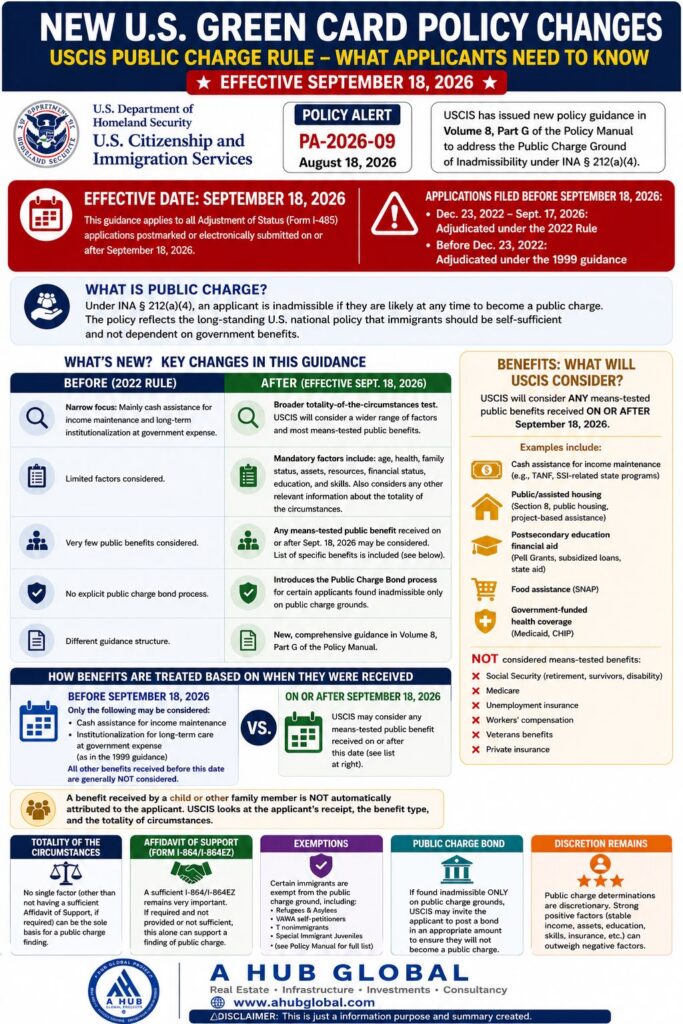
The guidance identifies potential examples including cash assistance, public/assisted housing, postsecondary education financial aid, food assistance, and government-funded health coverage. Social Security, Medicare and unemployment insurance are identified as not means-tested public benefits under this guidance. Importantly, benefits received by a child or another family member are not automatically treated as benefits received by the Green Card applicant.

USCIS generally looks at whether the applicant is actually listed as a beneficiary. The new guidance also addresses Affidavits of Support (Form I-864/I-864EZ), exemptions, public-charge bonds, and USCIS’s case-by-case assessment. No single factor—other than failure to provide a sufficient Affidavit of Support when one is required—can by itself determine the public-charge finding.
📌 Effective Date: September 18, 2026
📌 USCIS Policy Alert: PA-2026-09
📌 Issued: August 18, 2026
– Srinivasa Manapragada, A HUB GLOBAL, www.ahubglobal.com

DISCLAIMER: This post and accompanying infographic are provided for general informational and educational purposes only and are a summary of USCIS policy guidance. They do not constitute legal or immigration advice and should not be relied upon as a substitute for advice from a qualified immigration attorney or accredited representative. Immigration laws and policies may change, and individual circumstances can produce different outcomes. Please refer to official USCIS guidance for current requirements.